
How Bench Warrants Work in Grant County
A Grant County bench warrant is a judge’s order in a case that is already before the court. It often follows a missed hearing, failure to appear, contempt finding, or failure to obey another court direction. The warrant authorizes law enforcement to take the person into custody so the court can address the missed duty. It does not prove guilt on a new charge by itself.
Grant County public materials use “bench warrant,” “warrant for arrest,” and “failure to appear” as the ordinary terms. They do not use “capias pro fine” as the standard local name. A recall means the judge withdraws the warrant. A motion to quash asks the court to set it aside. The issuing judge controls either result, while the clerk records the order and the sheriff or police may serve it.
Grant County Bench Warrant Show-Cause Rules
The Grant County Sheriff Civil Process Division describes a local route from a court order to a possible warrant. A rule to show cause orders someone to appear and explain why an earlier court direction was not followed. The sheriff serves the paper. If the person does not appear, the court may issue an arrest warrant.
The sequence clarifies the agency roles: the court commands the appearance, the sheriff serves the process, and the judge decides whether noncompliance supports a warrant. Calling the sheriff does not replace contact with the court. The case docket and later judicial order determine whether the Grant County bench warrant remains active or has been recalled.
Bench Warrant Issuance in Grant County
The judge first finds that a required court act was missed. The clerk enters the event and warrant order on the case docket. Grant Circuit Court and Grant Superior Courts 1, 2, and 3 use the Grant County Clerk of the Courts. Marion City Court and Gas City City Court are separate courts with their own clerks and local dockets.
Indiana has no public statewide criminal-warrant search, and the Grant County Sheriff does not publish a complete active-warrant portal. Indiana MyCase is the practical public starting point for participating court records, but it is a case search rather than a live warrant-status repository. A docket entry should be confirmed with the clerk of the issuing court.
Grant County Bench Warrant MyCase Limits
The official MyCase search tips allow searches by case number, citation number, or party. A name search can be narrowed by first name, middle name, date of birth, court, open-or-closed status, and filing dates. Wildcard and sounds-like options help when spelling is uncertain.
The official MyCase access table shows that document access varies by case type and record. The source image below provides a visual reference for those limits.
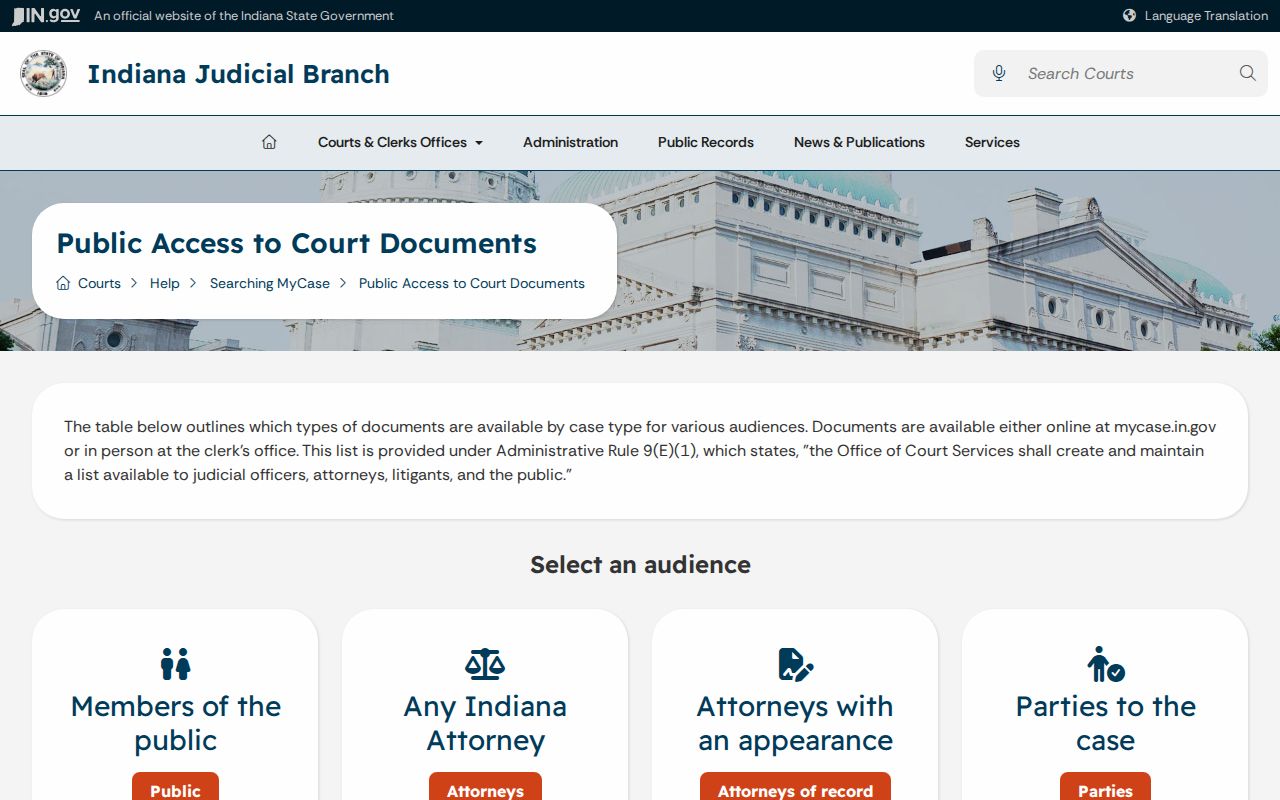
MyCase warns that it is not a complete criminal-history search and does not include every Indiana court. Unserved warrants, confidential material, juvenile matters, and sealed records may be withheld. No search result is not proof that no Grant County bench warrant exists.
How Bench and Arrest Warrants Differ
Both orders may authorize custody, but their origins differ. A bench warrant generally responds to a missed duty in an existing case. An arrest warrant begins with probable cause that an offense occurred and that the named person committed it. Indiana law requires specific information in an arrest warrant. A bench warrant instead points back to the court setting or order that was not followed.
| Feature | Bench Warrant | Arrest Warrant |
|---|---|---|
| Trigger | Missed setting or noncompliance | Probable cause tied to an offense |
| Who Issues It | The judge in the pending case | A judge after the required showing |
| Underlying Case | Usually an existing docket | Charging or investigation process |
| Next Step | Ask about reset, appearance, or recall | Plan surrender, counsel, bail, and hearing |
The separate Grant County arrest warrant lookup addresses the probable-cause order in more depth.
Grant County Bench Warrant Roles
The Grant County Clerk can locate a county case, identify the assigned court, provide the public docket, accept authorized filings or payments, and record the judge’s action. The clerk cannot promise that a warrant will be recalled. The judge controls the warrant. The sheriff serves the court’s order but cannot cancel it.
Grant County Clerk
101 E. 4th Street, Marion
765-668-8121
Weekdays from 8 a.m. to 4 p.m.
Grant County Sheriff
214 E. 4th Street, Marion
765-662-9836
Serving-agency confirmation; no dedicated warrant line is published.
The clerk’s official page confirms its custody of court records and payment duties. Ask for the case number, court, warrant event, and latest order before deciding what action is needed.
Clearing a Bench Warrant in Grant County
No countywide walk-in warrant window or published surrender protocol was found in the official Grant County sources. Do not assume that going to the sheriff, sending payment, or asking dispatch will withdraw the order. Start with the court that owns the case. If custody is possible, a lawyer can ask about a planned appearance, motion, and bail before the person goes in.
- Confirm the case number, issuing court, warrant entry, and current status with its clerk.
- Ask counsel whether a motion to recall or quash, a controlled appearance, or advance bond planning fits the case.
- Ask the clerk whether the judge requires a new date, hearing, payment, filing, or personal appearance.
- Complete the required act and keep the receipt, filed motion, hearing notice, and court order.
- Verify that the recall appears on the docket and reached any agency that held the warrant.
Caution: A payment receipt is not a recall order; confirm the judge’s action before treating a Grant County bench warrant as cleared.
Grant County Bench Warrant Appearances
Before a voluntary appearance, ask whether the warrant is active, whether counsel may file first, whether the judge has set a hearing, and whether bail must be reviewed in open court. Grant County local rules contain bail categories, but a schedule does not guarantee the amount or release terms in one person’s case. The warrant and the judge’s decision control.
Have the full name, date of birth, case number, and court name ready. Use the Grant County court staff directory to reach the assigned county court. Routine record questions should not go to emergency dispatch. The sheriff’s main office can answer agency-routing questions, but the issuing court must provide the case-specific resolution path.
Note: Court staff can give procedural information, but legal advice about a motion, surrender, or bail should come from a lawyer.
Grant County Courts That Issue Bench Warrants
Grant Circuit Court and Grant Superior Courts 1, 2, and 3 handle the county’s general-jurisdiction cases. Superior Court 2 also has the local IV-D child-support assignment. The Grant County Clerk supports these county courts. A case caption or number should identify the specific court, and that court controls the bench warrant.
Marion City Court, code 27H02, and Gas City City Court, code 27H01, are separate local courts for city misdemeanors, infractions, and ordinance violations. Marion City Court is at 301 S. Branson Street and uses 765-668-4425. Gas City Court is at 211 E. Main Street and uses 765-677-3081. The county court FAQ warns that they are not administered at the county courthouse.
Upland, Fairmount, and Jonesboro have local police, but no separate court for those towns was located in the official directory or local rules. Follow the citation, summons, or MyCase court line instead of assuming the town police control the warrant.
The court code prevents a common routing mistake. A Marion City Court case should not be sent to the Grant County Clerk simply because both offices are in Marion. Gas City’s clerk likewise controls Gas City Court files. When a paper notice is available, copy the court name, cause number, and hearing date exactly. If the notice is lost, search MyCase by name and date of birth, then read the court line before calling. The right clerk can distinguish an open case, a warrant event, a later recall, and a closed financial entry. That distinction is more reliable than asking a police office to reconstruct a court docket.
Grant County Traffic FTA Bench Warrants
A missed traffic date can produce more than one official consequence. The court may enter failure to appear, issue a qualifying warrant, and report nonappearance or nonpayment to the Indiana BMV. The BMV then handles a separate license-suspension process. Clearing a balance does not automatically prove that the court recalled a warrant or sent compliance to the BMV.
The official BMV failure-to-appear and payment page describes that state process.
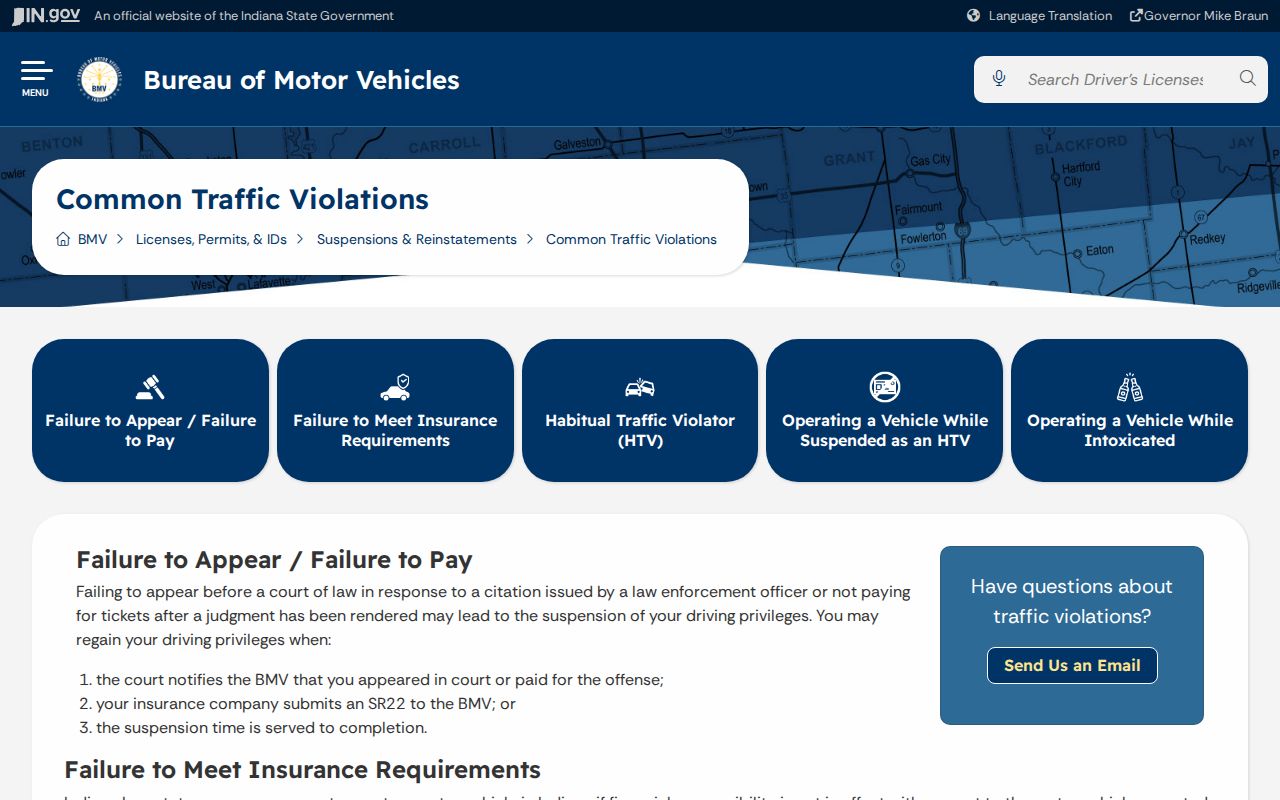
The image illustrates why the court warrant and BMV status require separate confirmation. Ask the issuing court what it reported and when, then check the BMV record through the state’s channel.
Confirming a Grant County Bench Warrant Recall
A recall is complete when the judge signs or enters the action and the court docket reflects it. Ask the clerk for the date and description of that order. If the sheriff or a city police department held the warrant, ask whether the court sent the update to that agency. This last check can catch a data-entry lag or an old screen.
Indiana’s public-access rules do not make every warrant record open. Unserved warrants may be confidential, and juvenile, sealed, or otherwise excluded records can remain restricted. The Indiana Judicial Branch request page sends local case-record requests to the county clerk. Request the public docket or order tied to the case rather than a broad history.
Grant County Crime Stoppers is an anonymous tip program, not a warrant database. Its official program page is shown only to distinguish that service from a personal warrant check.

The program’s public-safety tip channel cannot confirm or recall a Grant County bench warrant. The issuing clerk remains the correct source.