
Grant County Warrant Searches
Start with Indiana MyCase, the free public window into court files across the state. It searches cases, not a sheriff warrant roster, so bring the full legal name, any known birth date, a citation or case number, and the court or city where the matter began. Exact identifiers cut down false matches. Once results appear, read the chronological case summary for entries about a warrant, a failure to appear, service, a recall, or a quash. One source is never enough for a full Grant County warrant check. The sheriff posts no online active-warrant database, and Indiana has no public statewide criminal-warrant repository, so a complete Grant County warrant search runs through several channels. Follow each court record back to its custodian, and ask the issuing court to confirm current status before you act on anything.
- Search MyCase by case, citation, cross-reference number, or party name.
- Note the court, case number, status, next setting, and warrant-related docket entries.
- Contact the Grant County Clerk for Circuit or Superior Court cases, or the separate Marion or Gas City court for its cases.
- Call the Grant County Sheriff at 765-662-9836 for service-agency routing.
- Submit a narrow APRA request to the actual custodian when the record is not online.
Grant County’s Missing Sheriff Portal
The Grant County Sheriff website lists contacts and describes patrol and court-paper duties, but it posts no name-search form, no active-warrant roster, and no full most-wanted list. That gap changes how a warrant check works. A blank result can clear nobody. Your Grant County warrant search has to begin with the court record, then with the office that holds it. The sheriff still matters for service. Its Patrol Division says deputies serve arrest warrants and carry out court paperwork. The Civil Process Division delivers orders to appear and rule-to-show-cause papers, and its page warns that missing a court date can bring a warrant for arrest. Service is one job; issuance and recall are another. A judge issues the order, and only the issuing court can withdraw it. So call the sheriff for a service question, and use the docket for legal status. That split matters most after a recent arrest, surrender, or hearing, since the two records can update at different times. An old page or an unofficial search result is no substitute for live confirmation from the Grant County court that issued the warrant.
Grant County MyCase Search
Think of MyCase as an access layer. The court and its clerk keep the official record behind it. A last name starts a party search; first name, middle name, and date of birth narrow it. Wildcards and a sounds-like option help with unusual spellings, while court, case type, status, and filing dates trim broad results for a Grant County warrant check. No query returns more than 1,000 results. The official MyCase search tips document those controls in the state's own guidance.
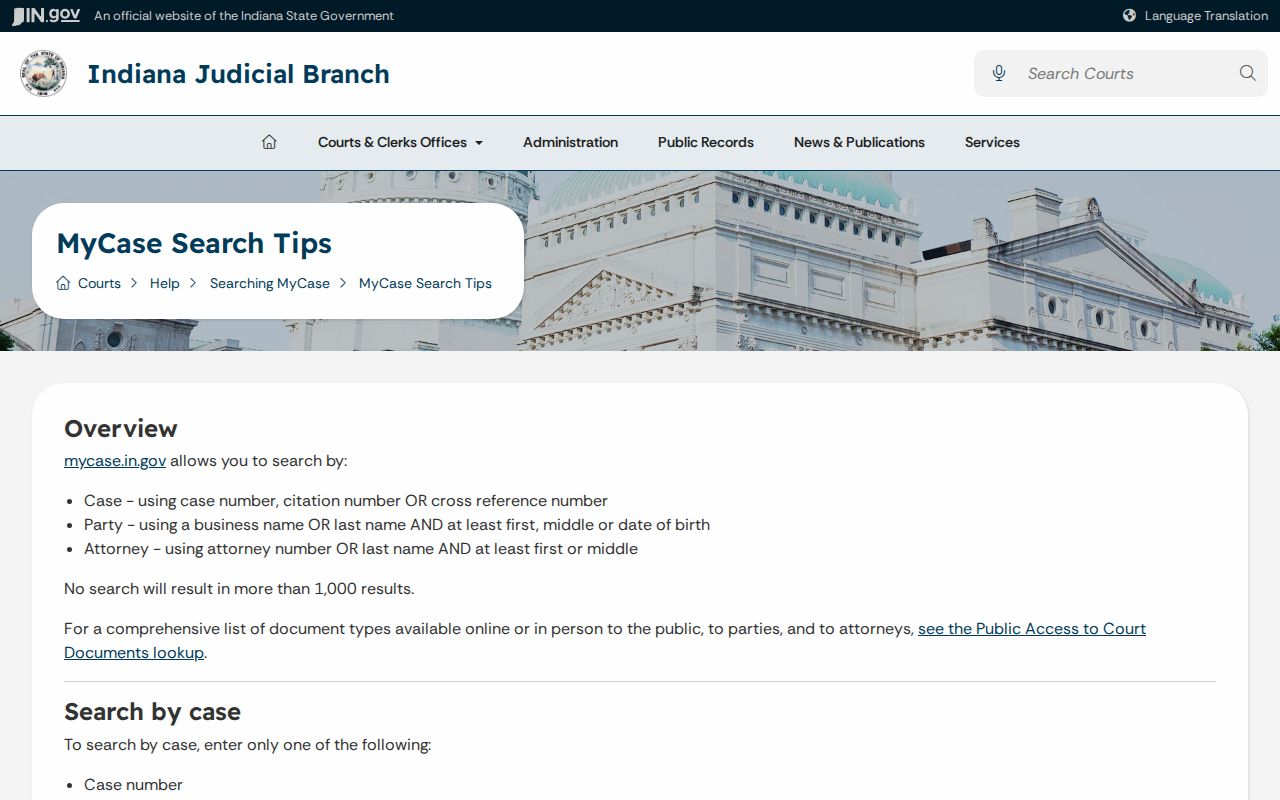
Filters tame common names, but they cannot turn MyCase into a complete Grant County warrant index.
What a Warrant Search Asks For
A known case or citation number is the cleanest route for a Grant County warrant search. Party searches help when the number is missing, though names demand careful checking. A birth date narrows results, yet it never appears in public case details.
| Field Label | Type | Required | Notes |
|---|---|---|---|
| Case number | Text | One identifier | Hyphens and leading zeros may be omitted. |
| Citation number | Text | Alternative | May be searched alone. |
| Cross-reference number | Text | Alternative | May be searched alone. |
| Last name | Text | Party search | Add first, middle, or birth date. |
| Court and case type | Filters | No | Court choice changes case-type choices. |
| Status and file date | Filters | No | Limit status and date range. |
The search button runs whichever route you chose. A result limit or a filter mismatch may force a sharper second try at a Grant County docket.
Grant County Court Filter Limits
Choosing Grant County plus a likely case type can make a search manageable, but it can also hide a record when the first guess is wrong. Criminal, misdemeanor, felony, infraction, ordinance, and civil matters each carry different events. Start broad, then narrow. If the first query was limited to open cases, run a second search without the status filter, because the displayed case status and a specific warrant event are not the same field.
Marion and Gas City City Courts sit apart from the county courthouse, and the county court FAQ makes that split clear. A city matter may need direct contact after MyCase. Keep in mind that a filtered-out result is not legal clearance. Upland, Fairmount, and Jonesboro have police departments, but the official Grant County court map lists no separate local courts for them, so a matter from those towns may still be filed in a county court.
A date of birth can narrow a party search, but it stays hidden from public case details and can even omit a record when the date was never entered. For a common name, compare the court, filing date, case type, and chronology rather than assuming the first match is the right person.
Grant County Warrant Search Results
A MyCase result can show a party name, case number, court, case type, filing date, status, chronology, and public documents. It will not look like a sheriff-style warrant card. Indiana Code 35-33-2-2 requires an arrest warrant to identify the person, the offense, the issue date and county, a signature and title, the arrest command, bail if any, and a direction to the sheriff, so a Grant County record with warrant details answers to that statute.
| Case number | An identifier such as 27D01-YY-F6-#####, shown only as an illustrative format. |
|---|---|
| Issuing court | The court whose docket must confirm status. |
| Chronology | Events may state issued, served, recalled, quashed, or failure to appear. |
| Offense | The charge tied to the case. |
| Bail | An amount if directed; release may still need judicial action. |
Grant County publishes no sample warrant listing online. A warrant number, service date, return, or judge comes from the docket or the clerk instead.
Confirming Grant County Search Hits
A name that pops up in a Grant County warrant search is a lead, not an answer. Before you act on it, line up the court, the middle name, the filing date, the case type, and any other identifiers in the public record. Those details keep one John Smith from turning into another man's problem. The Grant County Clerk sits on the first floor at 101 E. 4th Street in Marion and answers 765-668-8121 from 8 a.m. to 4 p.m. on weekdays. Staff there can tell you whether the docket you saw still shows the latest status. The city courts keep their own dockets. Marion City Court sits at 301 S. Branson Street and lists 765-668-4425, while Gas City City Court is at 211 E. Main Street with 765-677-3081. Only the issuing court can confirm that a warrant was recalled or quashed: recalled means withdrawn, and quashed means set aside.
Grant County Warrants: Who Holds What
Warrant authority in Grant County splits across several buildings. Grant Circuit Court and Grant Superior Courts 1, 2, and 3 issue the orders in county cases, and the Grant County Clerk maintains those records. Marion and Gas City each hold their own misdemeanor, infraction, ordinance, and failure-to-appear dockets. The sheriff's patrol deputies serve warrants and execute court paperwork. The department offers no public search form. Its sheriff page lists 214 E. 4th Street and 765-662-9836, with administration open 8 a.m. to 4 p.m. on weekdays. Non-emergency dispatch at 765-668-8168 routes calls; it is not a warrant desk. MyCase helps too, though it does not reach every court or restricted record.
Grant County APRA Requests
When a Grant County warrant lookup stalls online, Indiana's public records law gives you a written route. The Indiana Access to Public Records Act lets you ask the record holder directly, and a tight request gets the best results. Name the record type, the date range, the court or agency, and any case or citation number. Say whether you want to inspect the record or receive electronic copies. A narrow request spares staff from guessing which court, person, or event you mean. Grant County publishes no local warrant form, no warrant-search fee schedule, and no fixed response time, so your letter sets the shape of the ask. Match the request to the holder. The Grant County Clerk handles Circuit and Superior Court records, while a Marion or Gas City docket request goes to that city court itself. Ask the sheriff only for material the office keeps, such as service or return information. The Indiana Judicial Branch request guidance sends local case-record questions to the local clerk and notes that some records never appear through MyCase. Remember what the law does. APRA opens doors to records; it cannot make a court act, force out confidential material, or recall a warrant. A denial or redaction may rest on a statute, investigatory-record discretion, an order shielding an unserved warrant, or a court-access rule. Ask the custodian to state the basis for anything withheld. Then take questions about status or resolution to the issuing court or your lawyer.
Which Warrants Stay Restricted
Indiana treats court records as public unless a law or court rule says otherwise. A judge can order an unserved arrest or search warrant kept confidential. Juvenile warrants stay confidential in the ordinary course. Sealed, expunged, or excluded records may be missing from a Grant County file or handed over with redactions. Investigatory records can be withheld too.
Key rules:
Administrative Rule 9 governs court access, while Indiana Code 5-14-3 governs agency requests.
A missing record may reflect confidentiality, coverage, timing, or a separate city court.
Confirm a personal warrant question with the issuing court before concluding no order exists.
The MyCase access table shows which documents a Grant County searcher can view online and which require a trip to the clerk.